BRAINSTORMING IDEAS
25 brainstorming ideas for your team
These 25 brainstorming ideas help teams generate possibilities, explore different perspectives and turn promising ideas into practical next steps. Choose an exercise that fits your challenge, give everyone time to contribute and finish with a decision, an experiment or an owned action.
By Gotoclient · Last updated
Open up the possibilities
Use these exercises when the team needs fresh starting points.
- 01
Silent brainwriting
What could we try to solve this challenge?
Give everyone five minutes to write independently. Share the ideas together, then let each person build on one idea from someone else.
Take away: A first pool of ideas from across the team.
- 02
How might we?
How might we make this experience simpler?
Turn the challenge into three How might we questions. Choose the most useful one and write several possible answers before discussing them.
Take away: A focused opportunity statement and possible solutions.
- 03
Reverse brainstorming
What would make this problem much worse?
List ways to worsen the situation. Reverse each suggestion into a constructive improvement and compare the most practical options.
Take away: Improvements revealed by examining failure.
- 04
The constraints challenge
What could we achieve with half the time?
Choose one constraint, such as budget, time or team size. Generate ideas inside it, then identify which remain useful when the constraint is relaxed.
Take away: Resourceful options with explicit trade offs.
- 05
The ideal future
What would a great result look like in one year?
Ask each person to describe a concrete future result. Work backwards to identify the changes needed to make it possible.
Take away: A shared destination and early steps towards it.
Change the perspective
Look at the challenge through a different person, setting or assumption.
- 06
Customer point of view
What would a first time customer find confusing?
Review a real customer journey or supplied feedback. Write ideas from that viewpoint and mark anything that is an assumption to check.
Take away: Customer experience improvements grounded in available evidence.
- 07
Role swap
How would another team approach this?
Give each group a different role, such as operations, sales or support. Compare their proposals and the priorities behind them.
Take away: Options that account for different working needs.
- 08
Borrow from another field
How does a different industry solve a similar problem?
Invite examples participants already know. Identify the underlying principle and adapt it to your challenge, clearly separating analogy from evidence.
Take away: Adapted concepts to explore or test.
- 09
Assumption flip
What if one of our usual assumptions were different?
List the assumptions behind the current approach. Reverse one at a time and explore what becomes possible and what needs validation.
Take away: Alternative approaches and assumptions to investigate.
- 10
The newcomer lens
What would someone new ask us to explain?
Ask participants to describe the challenge in plain language. Capture questions a newcomer might ask and develop ideas for the gaps they reveal.
Take away: Simpler explanations, processes or experiences.
Improve what already exists
Build on real products, processes and experiences the team knows.
- 11
SCAMPER
What could we substitute, combine or adapt?
Examine an existing solution using substitute, combine, adapt, modify, put to another use, eliminate and reverse. Capture one idea for each useful lens.
Take away: A set of variations on an existing solution.
- 12
Friction hunt
Where do people lose time or momentum?
Walk through a real process. Mark frustrating moments and use observations or supplied data to propose a change for each one.
Take away: Specific fixes tied to identifiable friction.
- 13
Keep, change, scale
What deserves to stay, change or reach more people?
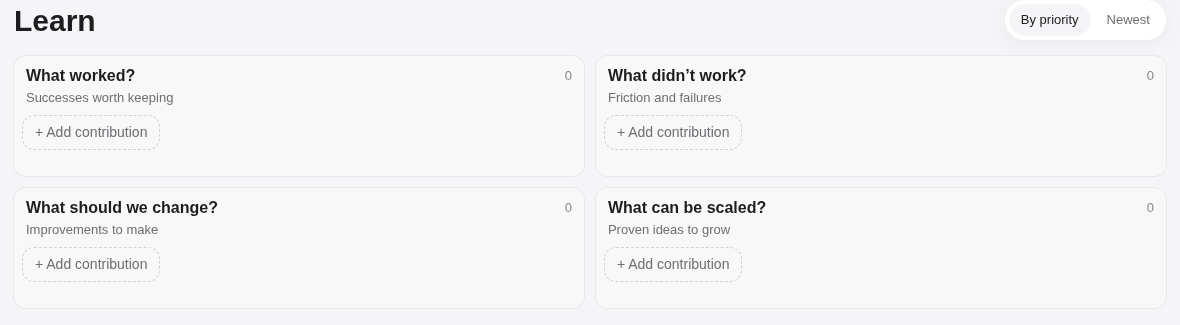
Review the current approach individually, then group suggestions by what works, what needs changing and what could be scaled.
Take away: A balanced improvement shortlist.
- 14
Simplify one step
Which step could become easier?
Select a process everyone understands. Propose ways to remove repetition, clarify a handoff or reduce effort while preserving necessary checks.
Take away: One practical simplification to test.
- 15
Combine two ideas
What becomes possible if we combine these?
Pair ideas from the first round. Describe what the combination adds, then check whether it solves the original challenge more effectively.
Take away: Stronger concepts built from shared contributions.
Challenge and test the ideas
Make uncertainties visible before committing people and resources.
- 16
What must be true?
What needs to be true for this idea to work?
Choose a promising idea. List its assumptions, identify which have evidence and decide how to test the most important uncertainty.
Take away: An assumption list and a validation step.
- 17
Premortem
Imagine this failed. What happened?
Give people time to write possible causes of failure independently. Discuss them together and propose safeguards for the most plausible risks.
Take away: A risk list with practical mitigations.
- 18
Smallest useful experiment
How could we test this in one week?
Reduce the idea to a small experiment. Define who takes part, what happens and what evidence would justify a larger commitment.
Take away: A bounded test with a success measure.
- 19
Evidence versus instinct
Which parts do we know, and which do we believe?
Separate supplied facts, observations and assumptions for each shortlisted idea. Decide what further evidence the group needs.
Take away: A clearer basis for comparing options.
- 20
Dependency detective
What has to happen before we can start?
List the approvals, information, people and other actions each idea depends on. Explore ways to resolve or reduce those dependencies.
Take away: A dependency map and ways to unblock progress.
Turn possibilities into next steps
Close the session with choices the team can explain and act on.
- 21
Impact and effort shortlist
Which ideas offer useful impact for manageable effort?
Agree what impact and effort mean for this challenge. Score each from 1 to 3 and discuss the trade offs before selecting actions.
Take away: A reasoned shortlist rather than a popularity ranking.
- 22
One idea, one owner
Who will take the first concrete step?
Turn each chosen idea into an action. Ask an owner to accept it, identify contributors and agree the first deliverable.
Take away: Owned actions with a clear starting point.
- 23
Success in one sentence
How will we know this worked?
Write one observable success statement for each action. Choose a measure, a target if appropriate and a date to review it.
Take away: Success measures the group understands.
- 24
Now, next, later
What belongs in each horizon?
Sort chosen actions into now, next and later. Check dependencies and capacity, then translate the horizons into realistic start and end dates.
Take away: A phased plan ready for scheduling.
- 25
The closing commitment
What will each of us do after this session?
Give everyone a moment to state their next step and any help they need. Review those commitments against the agreed actions before closing.
Take away: A shared record of commitments and support needs.
Bring your brainstorming into Mr. Workwick
Use your chosen question as the session prompt. Invite individual contributions, organise them into buckets and discuss the ideas worth developing. Connect selected insights to actions, owners, timing and success measures. Your own team guides the session.
Editorial guidance by Gotoclient. These are suggested exercises, including established methods such as brainwriting, SCAMPER and premortems, rather than claims of guaranteed results. Use them as human led prompts; this public guide is separate from your private workshop’s AI sources.
Questions people ask
- How do you run a brainstorming session?
- Define one question and the result you want. Share the context, set a time limit and invite each person to contribute before discussion starts. Group related ideas, compare their potential impact and effort, then agree which ideas to develop and who will take the next step.
- What are some useful brainstorming ideas?
- Try silent brainwriting, a How might we question, reverse brainstorming, role perspectives or a constraints challenge. Choose a method that fits the decision you need to make. Our brainstorming ideas guide explains 25 exercises with a prompt, a way to run each one and a useful output.
- Can we use AI during brainstorming?
- Use it to support review of what the group has written. Mr. Workwick’s live suggestions use only eligible text from the same workshop, are visibly labelled and need human review. When that writing is insufficient, the tool leaves the suggestion empty. Your team supplies the original ideas and decides what to pursue.
- How does brainstorming become an action plan?
- Choose an insight, state the action it suggests and explain why it matters. Assign an owner, record contributors and dependencies, choose timing and define a success measure. Review the expected outcome together and schedule the action so the session ends with a clear next step.
A Gotoclient workshop studio. More at gotoclient.com.
Ready for a workshop worth having?